Is Skydiving Scary? What to Expect and How to Prepare
Wednesday, October 21, 2026
Key Takeaways
Yes, skydiving is scary, but the fear peaks before you jump rather than during it. For most first-time jumpers, the open door of the aircraft is the most intense moment. Once you leave the plane, the sensation is much different from a roller coaster or bungee jump: there is no dramatic stomach-drop sensation. At full speed the air pushes back hard enough that the jump feels closer to floating than to falling. The best way to prepare is to know what’s coming, take care of your body, talk openly with your instructor, and give yourself permission to feel nervous.
Table of Contents
Is Skydiving Scary?
What is the Scariest Part of Skydiving?
What Does Freefall Actually Feel Like?
Should I Go Skydiving if I’m Scared?
What are the Odds of Getting Hurt Skydiving?
How to Mentally Prepare for Skydiving
Is Skydiving Good for People With Anxiety?
Why Do I Feel Weird After Skydiving?
Ready to Find Out What it Feels Like?

You’ve booked your skydive. You’ve probably told a few people about it. Maybe you’ve even watched videos of other people jumping. And now you’re thinking: “Wait… I’m actually going to do this?”
Yes, you are – and it’s completely possible to be excited and scared at the same time.
If you’re wondering, “Is it scary to skydive?” The honest answer is yes. But the part that feels scary may not be what you expect. For most first-time jumpers, the nerves build during the anticipation and reach their peak around the open aircraft door. Once you’re actually in freefall, the sensation is surprisingly different from the dramatic “falling” feeling you may imagine.
Knowing what those moments can feel like gives you something much more useful than a pep talk: a realistic picture of what’s ahead.
Is Skydiving Scary?
Yes. Skydiving can be scary, especially when you’re doing it for the first time. That doesn’t necessarily mean you’ll spend your entire skydive terrified.
Think about what happens before you even get on the airplane. You have time to imagine the jump, wonder what freefall will feel like, look at the aircraft, put on your gear, and watch other people prepare and land. Your brain has a lot of time to anticipate something it has never experienced.
That anticipation is a big part of how scary skydiving feels.
Once the airplane reaches altitude, however, there’s a point where anticipation ends and the experience begins. That point rests in the open door of a moving aircraft, 14,000 feet in the air.
What is the Scariest Part of Skydiving?
So, just how scary is skydiving and at what part does it hit maximum level? For many first-time skydivers, the open door is the hardest moment.
The ride to altitude gives your nerves plenty of time to build. As the airplane climbs, you know exactly what is coming. Eventually, the door opens and you’re looking at the landscape below while standing at the edge of the aircraft.
It can feel intense. Your heart may race. You might suddenly feel like you’d rather be anywhere else. You may even have a fleeting thought of, “What have I gotten myself into?” That reaction doesn’t require you to make a snap judgment about whether you should be there. Your instructor will be with you, and your pre-jump training will have already covered what to expect.
Then you exit.
The anticipation that occupied your mind for the last several hours is suddenly replaced by something very different: pure bliss.
What Does Freefall Actually Feel Like?
If you’re picturing skydiving as the sensation of standing on a tall building or dropping over the edge of a roller coaster, that’s not it. The reality is surprisingly different.
At altitude, the ground is so far below that you don’t have the same close visual reference you would from a roof, balcony, or bridge. Instead of looking down at a surface that seems immediately beneath you, you see a broad landscape that can look more like a map than a drop. That’s one reason people who are uncomfortable with conventional heights can be surprised by how freefall feels.
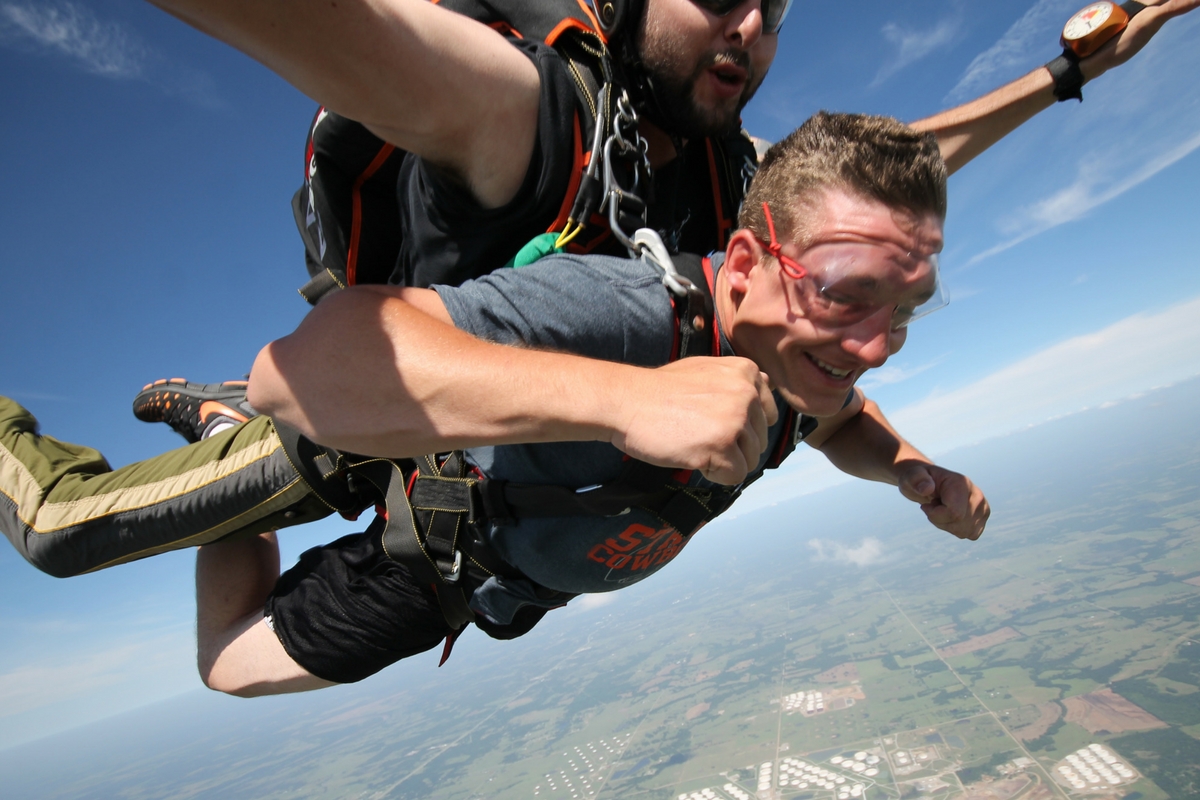
The physical sensation of freefall is different, too. When a roller coaster drops, you may feel that familiar rush in your stomach. Skydiving doesn’t produce the same abrupt sensation because you aren’t simply dropping through still air. As you accelerate, the air pushes against your body, creating strong, steady pressure across your front.
Oklahoma Skydiving Center’s typical tandem jump includes roughly 60 to 80 seconds of freefall before the parachute opens.
The result can feel more like floating on a powerful cushion of air than tumbling through empty space. You’ll hear the wind, feel the airflow across your body, and have a huge view of the landscape around you.
Should I Go Skydiving if I’m Scared?
When making the decision to skydive, it’s best to start by separating nervousness from genuinely not wanting to participate.
You can be excited about your jump and still have sweaty palms on the way to the dropzone. You can want the experience and still have a moment at the aircraft door when your brain says, “Absolutely not.” Those feelings don’t automatically mean you should cancel.
At the same time, you don’t have to force yourself through something you genuinely don’t want to do. If your fear feels overwhelming or you’ve changed your mind, talk with the dropzone staff rather than feeling pressured to prove something.
There’s a difference between “I’m nervous about doing this” and “I do not want to do this.” Knowing which one you’re feeling can help you make a decision you’re comfortable with.
What are the Odds of Getting Hurt Skydiving?
There isn’t one number that can predict an individual jumper’s chances of injury. The United States Parachute Association’s 2025 member survey found that 5.6% of surveyed members reported an injury requiring medical treatment during the year – with the most common being ankle injuries from landings.
The statistics include experienced, licensed skydivers. USPA reports that many serious incidents involve human judgment errors, including experienced jumpers performing aggressive or unnecessary maneuvers under canopy.
That matters when you’re looking at the numbers as a first-time tandem passenger. The injury statistics for the entire sport aren’t a direct measure of what happens on a tandem skydive. Your role is much simpler: pay attention during your briefing, follow your instructor’s directions, and communicate if you have questions or concerns.
How to Mentally Prepare for Skydiving
If you’re dealing with skydiving-for-the-first-time anxiety, preparation can give your mind something concrete to focus on.
- Practice controlled breathing
Try breathing slowly through your nose and exhaling through your mouth. Keep the breaths steady rather than taking rapid, shallow breaths when your nerves rise.
- Visualize the sequence
Picture the day from beginning to end: arriving, getting geared up, boarding the airplane, reaching altitude, approaching the door, exiting, freefalling, opening the parachute, and landing. You’re not trying to convince yourself that you’ll feel calm every second, you’re simply making the sequence familiar.
- Learn how the equipment works
Knowing what you’re wearing and how the tandem system works can make the experience feel less unfamiliar. Your instructor will explain the equipment and procedures during your preparation at the dropzone.
- Talk to your instructor
Tell your instructor that you’re nervous. Ask the questions that have been running through your head. You don’t need to hide your nerves or pretend you’re an expert skydiver.
- Get some sleep
Arrive rested. A good night’s sleep gives you a better starting point than showing up exhausted after spending the entire night thinking about your jump.
- Eat and hydrate
Have a normal, light meal and drink water before your jump. We recommend eating before skydiving rather than arriving on an empty stomach.
- Book a morning slot
If your schedule allows, a morning jump can keep you from spending an entire day waiting and wondering what the experience will be like.
Is Skydiving Good for People With Anxiety?
Some people with everyday anxiety find that having a structured experience, clear instructions, and an instructor beside them makes the process easier to navigate. But skydiving isn’t a treatment for anxiety, and it shouldn’t be approached as one.
If you have a panic disorder, significant anxiety, or a medical or mental-health condition that could affect your ability to participate, talk with your own clinician beforehand.
Your decision should be based on your individual circumstances – not on someone else’s experience or enthusiasm.

Why Do I Feel Weird After Skydiving?
The adrenaline rush doesn’t necessarily end the instant your feet touch the ground. Afterward, you may feel energized, shaky, emotional, tired, relieved – or some combination therein.
You’ve spent hours anticipating an unfamiliar experience, followed by a short period of intense sensory input. When you return to the ground and everything becomes ordinary again, it can take a little while for your body and mind to settle. Some people describe the feeling afterward as surreal: “Did I really just do that?” That’s one of the reasons getting video is such a valuable add-on.
Give yourself some time to sit down, drink some water, eat something, and take in what you just experienced.
Ready to Find Out What it Feels Like?
You don’t need to arrive at Oklahoma Skydiving Center feeling fearless. If you’ve decided you’re ready, breathe, listen to your instructor, and focus on the moment in front of you instead of everything you’ve imagined about it.
Book your jump with Oklahoma Skydiving Center and see what it’s like to jump with a dropzone with over 50 years of experience and professional USPA rated instructors. Blue skies, y’all!
Categories:
You May Be Interested In:
-

How Old Do You Have to Be to Skydive?
2 months ago by OklahomaSkydivingCenter
-
Can You Breathe While Skydiving?
3 months ago by OklahomaSkydivingCenter
-

Is There a Weight Limit for Skydiving? What to Know Before You Jump
4 months ago by OklahomaSkydivingCenter
-

What to Eat Before Skydiving (And What to Skip)
5 months ago by OklahomaSkydivingCenter
Contact Info
Skydiving Safety
Each one of our skydiving instructors is thoroughly trained, highly experienced, and safety minded.

Copyright © 2026, Oklahoma Skydiving Center, All Rights Reserved.
DropZone Web Design & Marketing by Beyond Marketing, LLC